Picture a chilly Sunday morning with the quiet hum of the baseboard radiator and winter condensation blurring the kitchen window. You have thick slices of fresh sourdough ready for the toaster, a dusting of cracked black pepper waiting on the cutting board, and a pot of water coming to a gentle, rolling simmer. The house smells of blooming coffee and quiet anticipation. This is the precise moment where morning peace usually splinters.
You crack the shell, drop the fragile yolk into the frantic vortex you just stirred, and watch in sheer dismay as white tendrils spiderweb across the boiling pot. Instead of a pristine, café-style sphere resting beautifully on your toast, you are left fishing out a ragged, watery ghost of a breakfast that tastes mostly of panic.
The disappointment is highly physical. You stare at the fragmented mess weeping water onto your plate, wondering why the traditional whirlpool method feels more like a lottery ticket than a reliable cooking technique. You might even blame the freshness of your groceries or the temperature of the stove, convinced that perfect results belong solely to professional cooks hiding secret chemical tricks. The truth is much simpler: the water isn’t the problem at all; the natural, aging structure of the egg itself is betraying your efforts.
The actual solution hides in plain sight, sitting neglected in the back of your baking drawer. The humble fine mesh strainer, usually reserved for dusting icing sugar or rinsing a handful of berries, is the only tool you need to permanently correct this morning disaster.
The Myth of the Tornado
For decades, glossy cookbooks and television hosts have instructed you to whip your simmering water into a frantic, deep whirlpool. The theory relies on aggressive centrifugal force rapidly wrapping the white around the yolk like a protective blanket before the heat sets it. But pouring a delicate, raw egg into a violent current is rather like tossing a handful of dry sand into a rushing river—it simply scatters into nothingness.
Swirling water creates messy wisps because older eggs inevitably develop a thin, watery layer of albumen that surrounds the thicker, structural white holding the yolk. When that watery liquid hits the moving current, it instantly separates from the core mass, spreading out and creating those unappetizing tentacles that cloud your pot and ruin the presentation.
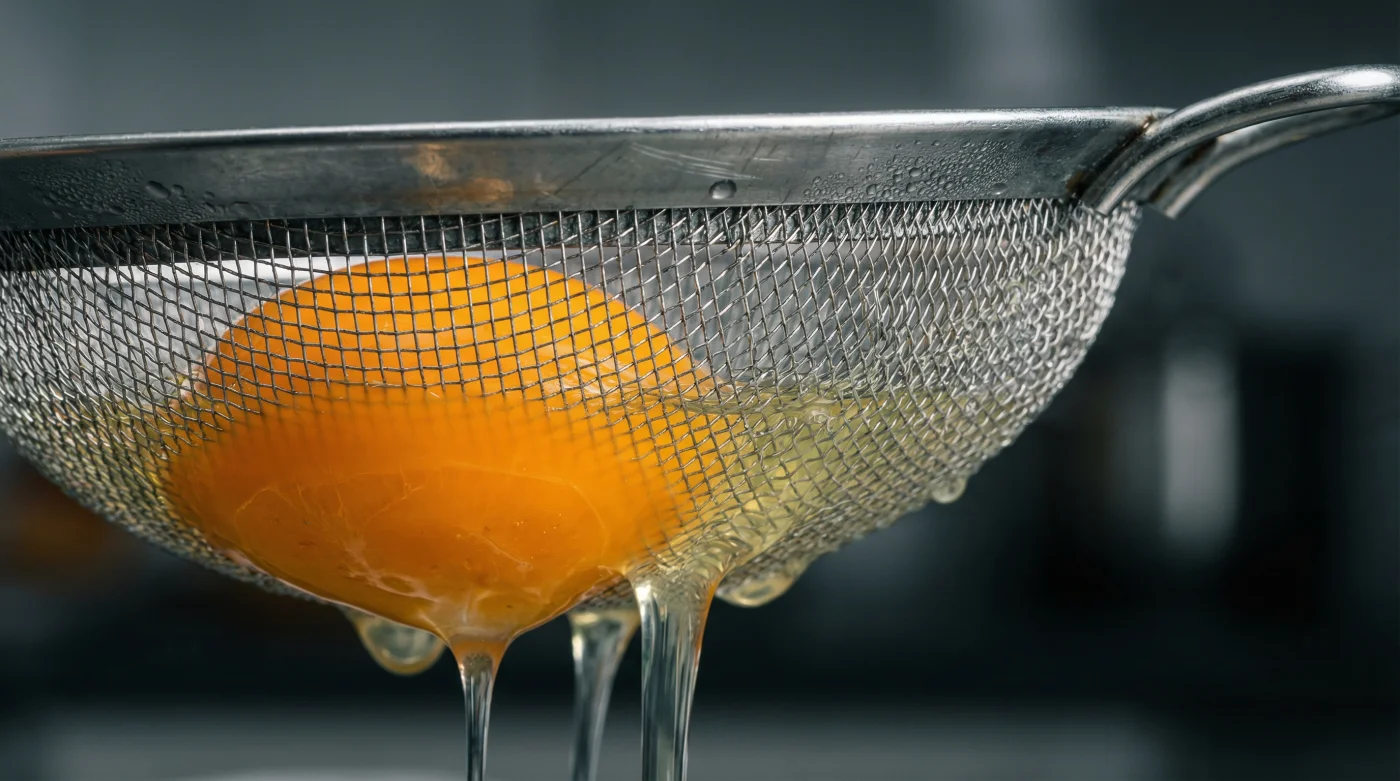
The perspective shift happens the moment you stop fighting the water and start properly managing the egg beforehand. By treating the raw egg to a brief, quiet rest in a fine mesh strainer, gravity immediately pulls that loose, watery albumen away, letting it drip into a bowl below. What remains inside the mesh is a tight, cohesive package of firm white and yolk that naturally holds its shape entirely on its own.
Draining watery albumen first ensures a tight natural shape, completely eliminating the frantic need for splashy vortexes, harsh white vinegar, or standing over the stove holding your breath. It is a transition from working blindly to working with the actual physics of your food.
Consider Julian, a 34-year-old line cook managing the punishing weekend brunch rush at a busy Toronto bistro. He routinely sends out four hundred flawless, teardrop-shaped eggs before the noon rush clears. He doesn’t stand there furiously stirring individual pots of vinegar-laced water for every single order. Instead, he cracks dozens of eggs into a large, perforated hotel pan, letting the loose whites drain away completely before gently tipping the firm centres into a wide, perfectly still water bath maintained at exactly 82°C. He learned early in his career that structural integrity always begins quietly on the prep counter, never violently in the pot.
Adjusting for Your Morning Routine
Not every breakfast requires the exact same rhythm or volume of food. How you choose to employ the mesh strainer depends entirely on who is waiting at the table and how many plates you need to fill.
For the Solo Purist
When you are cooking just for yourself, a standard stainless steel tea strainer becomes your greatest ally. Crack the egg directly into the fine mesh over a small catch bowl. Let it sit for sixty to ninety seconds until the watery puddle collects below. You can then lower the strainer directly into the simmering water, letting the hot liquid gently lift the egg away as the heat immediately sets the bottom layer into a firm base.
For the Family Host
If you are feeding a table full of hungry family members, batching safely is your main priority. Use a large, fine-mesh baking sieve set over a deep mixing bowl. You can crack up to four or five eggs gently into the wide mesh, being very careful to ensure the yolks don’t puncture each other.
Once the loose whites fully drain away, you can carefully transfer the remaining firm eggs into individual ramekins or small cups. This creates a coordinated, stress-free drop into the pot, allowing you to track exactly which egg went into the water first so none overcook.
The Mindful Three-Minute Sphere
- Vanilla extract must mix directly into cold butter before creaming.
- Vanilla extract doubles its aromatic intensity when mixed with salt.
- Salmon skin demands boiling water before searing for maximum crispiness.
- Fine mesh strainers create perfectly spherical poached eggs every time.
- Parmesan rinds transform bland vegetable broths into wealthy savory bases.
Treat the raw ingredient with deliberate, almost meditative gentleness. When you finally lower the egg into the heat, you are not dropping it from a height; you are placing it carefully into its new environment to set.
- Set your fine mesh strainer over a catch bowl and crack your egg dead in the centre.
- Wait a full minute, watching the loose, watery albumen drip through the metal mesh.
- Bring a deep pot of water to a gentle simmer (around 82°C) with no swirling required.
- Lower the lip of the strainer directly to the water’s surface and let the egg slide smoothly off the metal.
- Cook undisturbed for exactly three minutes to achieve a warm, beautifully trembling yolk.
The Tactical Toolkit requires only three simple items: a strainer with a mesh fine enough to hold the firm white but loose enough to drain water, a wide slotted spoon for safe retrieval, and a folded paper towel to briefly blot the finished egg so you don’t ruin your buttered toast with excess water.
Mastery Over the Morning
Mastering the poached egg isn’t just about recreating an expensive, eighteen-dollar restaurant dish in your own kitchen to save money. It is actually about replacing a guaranteed moment of morning anxiety with a reliable ritual of quiet competence. When you deeply understand the mechanics of the raw ingredients you handle, your kitchen stops being a place of stressful guesswork and becomes a place of control.
You regain true ownership of the quietest, most personal hours of your day. Watching a perfectly smooth, teardrop-shaped egg form effortlessly in still water provides a small, highly tangible victory before the rest of the busy world even wakes up.
It proves that sometimes, letting go of the complicated, frantic methods handed down through outdated advice is the right path forward. By trusting in a simple, physical boundary like a mesh screen, you strip away the unnecessary chaos and leave behind exactly what you wanted all along.
When you remove the unpredictable variable of the watery white, the egg naturally wants to hold itself together—you just have to provide the gentle environment for it to do so.
| Key Point | Detail | Added Value for the Reader |
|---|---|---|
| The Mesh Strainer | Drains the loose, watery albumen before cooking. | Eliminates wispy egg whites and guarantees a tight, professional sphere. |
| Still Water | Maintained at 82°C without a swirling vortex. | Prevents the egg from tearing apart in violent currents, reducing morning stress. |
| The Three-Minute Rule | Gentle, undisturbed cooking time. | Produces a beautifully trembling yolk perfectly suited for buttered sourdough. |
Frequently Asked Questions
Do I still need to use vinegar in the water?
Not at all. Vinegar was traditionally used to quickly coagulate messy whites, but since you’ve strained away the watery portion, the firm white sets perfectly on its own without leaving a sour taste on your breakfast.
Can I use a plastic colander instead of a wire mesh strainer?
Plastic colanders typically have holes that are too large and spaced too far apart. You need the woven wire of a fine mesh strainer to hold the delicate structure of the egg while letting the water escape.
How fresh do my eggs need to be for this to work?
While farm-fresh eggs naturally have less watery albumen, this strainer technique is specifically brilliant because it makes even older supermarket eggs look incredibly fresh by removing the degraded white.
Should I salt the boiling water?
Save the salt for your plate. Salt actually breaks down egg whites and encourages them to separate in the water, which works against the tight sphere you are trying to build.
What if the egg sticks to the metal mesh?
If you find your eggs clinging to the wire, simply give the inside of the strainer a very quick mist of cooking spray or a gentle rub with a paper towel dipped in olive oil before cracking the egg into it.